


Forest Value Chain Association Chairman’s Report
INTRODUCTION:
The Forest Value Chain Association of Kenya (FVCAK) is a fully registered umbrella Association for some if not all forest industry players along the entire Value Chain. These include but not limited to tree seed dealers, tree seedling growers, saw millers, fuelwood merchants, charcoal makers, wood composite manufactures contractors etc.
AIM
The aim is to try and sort out the glaring functional and business disconnects that exist between various players along the value chain. All the stakeholders should participate in conservation.
We also intend to deliberately partner with the government to ensure alignment with its policies, reforms, and information sharing. Through this platform, the government should be able to reach out to all the players at a click of a button. By this arrangement, we hope to achieve self-regulation by the forestry stakeholders which will help reduce the issues that have triggered moratoriums in the past.
As the government seeks to drive reforms in other sectors, we also want to align and comply on matters such as procurement, taxation, climate change, gender parity, etc. To us this conversation can only be postponed but not avoided.
Our agenda for some Forest Value Chain players include:-
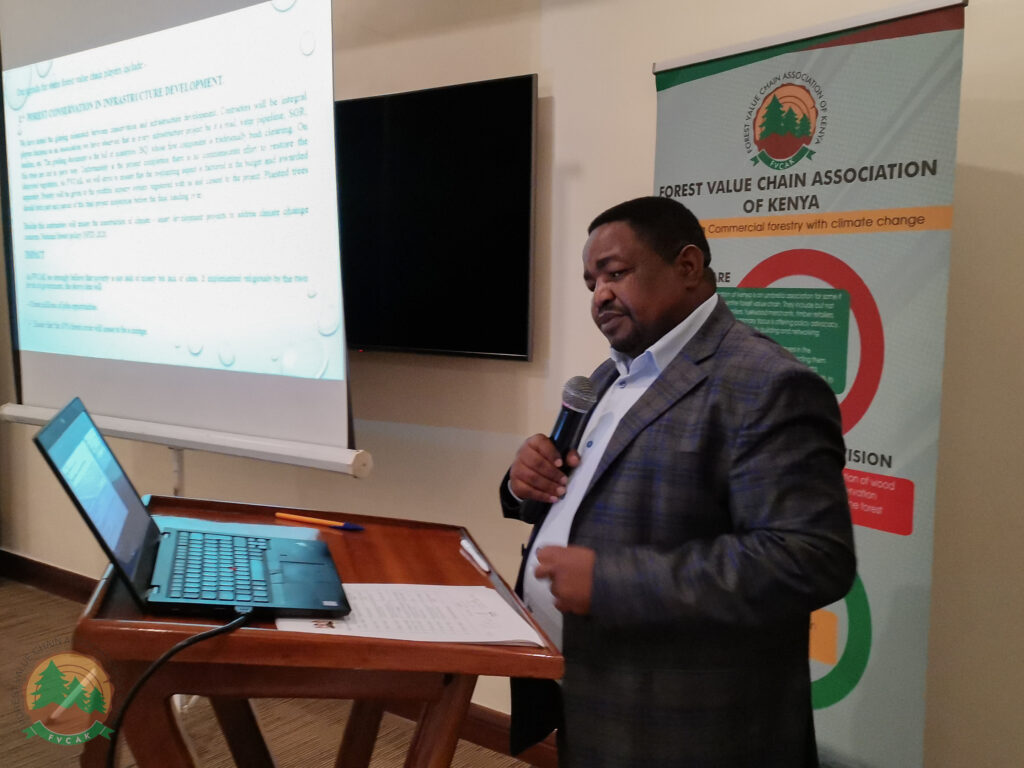
- FOREST CONSERVATION IN INFRASTRUCTURE DEVELOPMENT.
We have noted the glaring mismatch between conservation and infrastructure development. Contractors will be integral players because as an association we have observed that in every infrastructure project be it a road, water pipeline, SGR, stadium, etc.
The guiding document is the bill of quantities (BQ) whose first component is traditionally bush clearing. On this trees are cut to pave way. Unfortunately at the project completion there is no commensurate effort to restore the destroyed vegetation. As FVCAK, we will strive to ensure that the re-planting aspect is factored in the budget and awarded separately. Priority will be given to the youthful nursery owners registered with us and closest to the project. Planted trees should form part and parcel of the final project inspection before the final handing over.
Besides this contractors will ensure the construction of climate – smart development projects to address climate change concerns. National Forest Policy (NFD) 2020.
The aim is to try and sort out the glaring functional and business disconnects that exist between various players along the value chain. All the stakeholders should participate in conservation.
IMPACT
As FVCAK we strongly believe that poverty is not lack of money but lack of ideas. If implemented religiously by the two levels of government, the above idea will
- Create millions of jobs opportunities.
- Ensure that the 30% forest cover will cease to be a mirage.
On the same agenda but at the advocacy level we will push to ensure that the two levels of governments will include the supply of and planting of tree seedlings as a separate category in their procurement pre-qualification adverts alongside others like computers, stationery, furniture etc.
We also wish to see ‘bush clearing’ as used in (BQs) changed to read relocation and restoration of vegetation on site. This should be done in partnership with Kenya Forest Service (KFS) and Kenya Forestry Research Institute (KEFRI) to ensure that in replanting, and as a way of cutting the maintenance cost, priority goes to tree species that were existing in the ecosystem naturally and accurate species-site matching is enforced.
Further, the anchorage of this agenda will be on the project defects and liability period which is usually six months. Any tree seedling planted and nurtured for six months should be able to survive afterwards on its own. This is direct job-creation for nursery owners not mentioning the multiplier effect.
Relevant to our goal is the National Environment Management Authority (NEMA). On this, we intend to partner through information sharing to ensure compliance with the environmental component captured on every Environmental Impact Assessment Report. This will attract a certificate which will be a mandatory requirement for contractors just like the Tax Compliance Certificate. Membership in our association and proof of attendance to our trainings will be a added advantage .This will help boost adherence.
- WOOD INDUSTRY REFORMS
In the sawmilling sector our intention is to empower sawmillers to manufacture timber and timber products with improved recovery meeting global standards, access to credit, training on business prudence & ethics, compliance to government regulations, self-regulation, business continuity planning, business contracting, etc. To deliver on this, we will partner with strategic players like sector expert trainers, donors, government agencies like KEFRI, KRA etc. all which summarizes the challenges that impede the sector business growth and continuity. (Muthike et al..2019)
Research products by KEFRI can be passed on to sawmillers for adoption .This will provide alternative livelihoods to sawmillers and other sector investors reducing over-dependency on conventional sawmilling and timber trade.
- UNIVERSITY AND EMPLOYER LINKAGES.
In order to boost the industry, we intend to establish job and attachment linkages with universities and colleges. On this universities will be sharing their student details and units covered then we can recommend appropriate wood industries that can offer appropriate exposure relevant to areas of specialization. By doing this, our contribution to the training sector will be fundamental in ensuring adequately trained workforce for economic development. Our National and Regional chapters to steer this proposal. We also intend to partner with Government and training institution to create adequate job placements for the trained workforce at different levels in the forest industry.
- CHARCOAL INDUSTRY
Attempts will be made to streamline operations of the charcoal industry players through membership recruitment, pushing for appropriate legislation at the county assemblies level, foster their participation in tree growing to ensure sustainable supply to their industry.
This will be done in close collaboration with KFS, KEFRI, ministries of Trade and Energy for technical support. Emphasis will be on promoting access to fast-maturing tree species, improved charcoal kilns, improved cookstoves and access to waste wood from sawmills, markets etc.
- BOARDROOM PRESENCE.
In conjunction with the Council of Governors (COG) our Association will lobby for slots in the county Environmental Boards to offer guidance and coordination of activities related to our Association. This will include but not limited to tree growing activities, liaison with universities and colleges in the region and support to Ecosystem conservation since forestry is a devolved function.
- PUBLIC -PRIVATE PARTNERSHIPS
In liaison with the National FVCAK office, the county chapters will initiate and midwife public- private partnerships agreements to engender conservation both in public and private land for specified number of years.
- ROAD BEACONS
Besides the above partnership with development agencies like KERRA, KURA, KENHA, Public works etc. we will push to promote the use of trees as beacons on government lands, railways and roads reserves. This will help curtail grabbing and encroachment on road reserves and government land which results in disputable compensation claims. The area administrative officers will ensure care and protection of such beacons. This will help phase out the concrete posts which add no value to the environment .Compliance ratings for counties should be pegged on such parameters among others. Attempts to include some fruit trees on this agenda can boost nutrition and food security. A case in mind is the haphazard mango trees on government land and forests in Ukambani which feed hundreds when in season.
WAY FORWARD
As a way forward and a starting point, attention should go to the sawmilling industry which has suffered a moratorium since 1999 to 2012 and again since 2018 to date. Investigations have been going on
culminating in the recently concluded Auditor General’s Report.
During this moratorium businesses have suffered, livelihoods have been disrupted, saw millers have been auctioned due to unserviced loans, health issues raging from pressure –related complications to mental cases have been reported among our members.
The construction industry in Kenya has since been relying on imported timber from neighboring countries. This has led to massive cash freights in addition to consumers getting products that don’t meet the required standards. In a recent colloquium at KEFRI headquarters, the KEFRI CEO Dr. Kiboiwo highlighted statistics that painted some disturbing images on the trade imbalance.
The other source of timber has been private farms. Demand-driven pressure has been on the private farms where underage trees have been over exploited. This raises concerns over the quality of timber being injected into the market and the effects this has on the quality of end use.
In the same vein and as we reopen the forest, let us consider closing private farms to ease pressure on the same and allow the trees to mature.
It is worth noting that commercial trees are a crop like any other with planting and harvest seasons. After massive investments by the government in forests over years, trees have over- matured far beyond the maturity age. This has caused massive rots with trees that were meant for timber ending up as fuel wood at the best. The consequent price disparity is disturbing. Job, time and revenue losses follow. Mt. Kenya and Ukambani counties are among the most affected by this state of affairs. Makueni for instance has double the amount of materials ready for harvesting to that in Kiambu.
The sad end result is that the KFS mandate has been partially fulfilled when tree growing efforts do not match harvesting. This is totally an- unscientific way of managing plantation forests. This state of affairs has created serious animosity between the government and communities that depend on timber industry especially in Mount Kenya and the rift valley regions. To sort this out, we propose that the government moves swiftly to release and implement the Auditor General’s Report which will allow immediate access to the paid-for-but-unharvested materials. This will be a major painkiller before the tender for sale of materials are advertised. This proposal does not in any way shield or exonerate any industry player whose credibility in dealing with KFS may have been identified as wanting. Such should be dealt with in accordance with the prevailing regulations and the law.
All the counties that issued a memorandum to the PS-environment dis-associating themselves with the court case should be allowed to do business. This will help deter unwarranted and disruptive litigations by timber industry investors in future. Problems in one county should not be allowed to disrupt business in the entire country. The use of circuit breakers in buildings is a perfect example.
We take the earliest opportunity to assure the government that we have learnt our lessons, we have reformed, reorganized and ready to support the government’s reform agenda for posterity.
By doing this the government will have played its role as a peace and unifying agent and consequently boost support to government agenda including the on-going preparation for elections
Finally we encourage the government to embrace dialogue and public participation especially now that we have a credible Association before major decisions touching on the industry are made. We also appeal for support both financial and technical to strengthen the Association in order to deliver on our promises.
REFERENCES
- George Muthike and Joseph Githiomi, 2020. Value Chain Analysis of Farm Grown Melia volkensii (Gurkii) Timber in the South Eastern Drylands of Kenya (Journal of Horticulture and Forestry Vol. 12(4), pp. 115-121, October-December 2020. DOI: 10.5897/JHF2020.0641 Article Number: 120CC7765645 ISSN: 2006-9782.
- Muthike G, Karega S and Githiomi J, 2019. Extent, Distibution and Causes of Defects in Soft Wood Plantation in Kenya. E. Afri. Agri. For. J (Pg 166-171 Special Issue), 2020.
Muthike, G., Ali, G., Oduor, N., Munene, P., & Githiomi, J. (2022). Corrective Interventions to End Splitting and Surface Cracking in Kenya Grown Eucalyptus grandis Poles. Open Journal of Forestry, 12, 380-392. https://doi.org/10.4236/ojf.2022.123021
Poline wangari
August 18, 2022This is the only way forward
melitech_dev
August 19, 2022True.
Thank you.
Dr. George Muthike
October 10, 2022This is wonderful Piece. Keep Moving